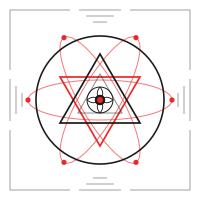
This idea emerged while studying the Hoysala temples at Belur and Halebidu. The sculptural programmes on these temples follow recursive, self-similar patterns that are strikingly reminiscent of computational fractal generation.
The pattern
The vimana (tower) of a typical Hoysala temple is not merely decorative — it follows a generative grammar. Each layer of sculptural detail is a transformation of the layer below it, scaled and rotated according to rules that could be expressed algorithmically.
This is not a modern projection onto ancient work. The Manasara and Mayamata — Sanskrit treatises on architecture — describe temple construction in procedural terms that read remarkably like pseudocode: take this unit, multiply by this ratio, repeat at this interval.
What this means
If temple architecture is computational, then the master builders (sthapatis) of the 12th century were doing something we would recognise today as parametric design — centuries before the term existed.
The invisible becomes visible when you change the lens through which you look.
More to come as I develop this line of thinking.